Lithium Iron Phosphate Battery Market Share Q&A
Explore LFP battery market share, top competitors, and growth drivers with affiliate-focused Q&A insights built for SEO and featured snippets.
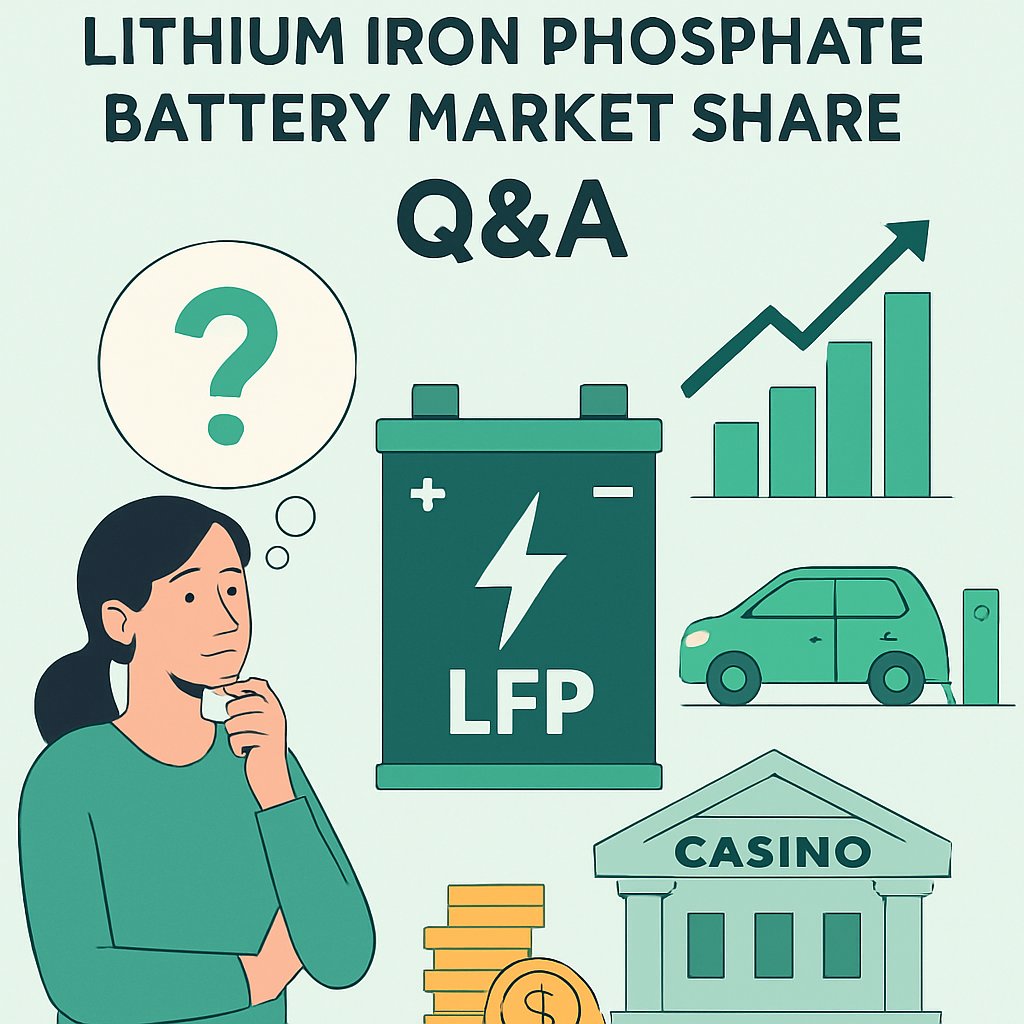
Lithium Iron Phosphate Battery Market Share Q&A
Lithium iron phosphate (LFP) batteries are reshaping energy storage, EV adoption, and industrial power systems. For casino affiliates, understanding LFP battery market share and the competitive landscape matters because it reveals where capital, tech adoption, and consumer demand are moving. This Q&A breaks down the market in simple terms, with practical insights on suppliers, growth drivers, and how to evaluate opportunities in adjacent content and affiliate campaigns.
What is the lithium iron phosphate battery market share right now?
The lithium iron phosphate battery market share is growing quickly, especially in electric vehicles, stationary storage, and low-cost power applications. LFP has gained share because it is safer, longer-lasting, and typically cheaper than nickel-rich chemistries. In many EV segments, LFP now accounts for a major portion of battery installations, particularly in China and increasingly in North America and Europe. For affiliates covering energy, EV, or industrial technology, this matters because market share often signals where manufacturers are investing, where search demand is rising, and which brands are becoming more visible. The competitive landscape is led by large cell makers and integrated EV suppliers, but smaller innovators can still win on niche performance, packaging, or supply-chain efficiency. Example: LFP is often preferred in fleet vehicles and home storage systems because cycle life can exceed 3,000 to 6,000 cycles. Next, track regional share trends and supplier announcements.
How do I compare the competitive landscape of LFP battery manufacturers?
Compare LFP battery manufacturers by capacity, cost per kWh, safety performance, supply-chain control, and customer concentration. The best way is to build a simple scorecard that includes production scale, patent strength, regional footprint, and end-market exposure. Large manufacturers often compete on price and volume, while specialized players compete on thermal stability, fast charging, or module design. For casino affiliates creating industry content, this comparison helps you identify which brands are most likely to attract search interest, press coverage, and investor attention. You should also look at who supplies EV OEMs versus energy storage integrators, because those channels have different growth rates and margins. Example: a manufacturer with gigawatt-hour scale and long-term EV contracts usually has a stronger competitive position than a smaller regional supplier. Action item: follow quarterly earnings, capacity expansions, and partnership announcements to spot momentum early.
Why should I care about LFP battery market growth as a casino affiliate marketer?
You should care because fast-growing markets create content opportunities, search demand, and monetization angles across finance, EV, and technology niches. Even if your core business is casino affiliate marketing, understanding adjacent high-growth sectors helps you diversify content and build topical authority. LFP battery growth is driven by EV adoption, energy storage deployment, and the push for safer, lower-cost batteries. Those themes generate news cycles, investor interest, and comparison searches that affiliates can capture with well-structured Q&A content. The competitive landscape also shows which companies are scaling, which can inform trend-based articles, email newsletters, and social updates. Example: when a major automaker shifts more models to LFP, search interest often spikes around battery safety, cost, and range. Next step: monitor market reports and earnings calls to turn industry movement into timely, SEO-friendly content.
When is the best time to publish content on the LFP battery market?
The best time to publish is when the market has a clear catalyst, such as an earnings report, plant expansion, EV launch, policy update, or storage-sector forecast. Timely publishing helps you capture spikes in search interest before competitors saturate the topic. For featured snippets, publish early in the news cycle with a concise definition, then update the article as new data arrives. This is especially useful for affiliate publishers who rely on freshness and relevance. In practical terms, the strongest windows are after quarterly results from major battery suppliers, during auto show announcements, and when governments announce clean-energy incentives. Example: if a top battery producer reports a 20% capacity increase, related searches for LFP share and competition often rise within days. Action item: set alerts for industry news, then refresh your Q&A content within 24 hours of major developments.
Which LFP battery companies are better for energy storage versus EVs?
Companies with deep manufacturing scale and strong OEM relationships are usually better for EVs, while firms with system integration strengths often perform better in energy storage. EV buyers prioritize energy density, charging speed, and automaker certification, while storage customers care more about safety, uptime, and total lifecycle cost. That means the competitive landscape is not one-size-fits-all. Some suppliers dominate automotive supply chains, while others win in residential or utility-scale storage. For content creators, this distinction is valuable because it lets you target different search intents: EV battery market share, home battery backup, or grid storage performance. Example: a supplier with large EV contracts may be the right company to feature in an automotive article, while a module-focused brand may be better for solar storage coverage. Next step: segment your coverage by use case, not just by company name.
How much does it cost to track the LFP battery market share and competitors?
Costs range from free to several thousand dollars per month, depending on data depth and reporting frequency. Free sources include company earnings calls, press releases, government statistics, and trade publications. Paid tools add market sizing, shipment estimates, competitor benchmarking, and analyst forecasts. If you are a casino affiliate using content to attract traffic, you may not need premium enterprise research at first; a combination of public filings and trend monitoring can be enough to build strong articles. However, paid data becomes valuable when you need precise market share estimates or investor-grade comparisons. Example: a subscription report may cover global LFP capacity, regional share, and top suppliers, while free sources only give partial visibility. Action item: start with public data, then upgrade only if the topic consistently drives traffic or revenue.
Conclusion
Lithium iron phosphate battery market share is expanding because buyers want safer, cheaper, longer-life energy storage. For casino affiliates, the lesson is clear: fast-growing markets create valuable content opportunities, especially when you can explain competition, timing, and use cases in a simple Q&A format. Bankrolls.com helps affiliates manage campaigns, track performance, and optimize revenue so you can turn timely industry coverage into measurable growth. Use it to simplify reporting, identify winning pages, and scale smarter. Sign up for Bankrolls today
Tags
Bankrolls AI
AI-powered content generation for casino affiliate marketing insights.